
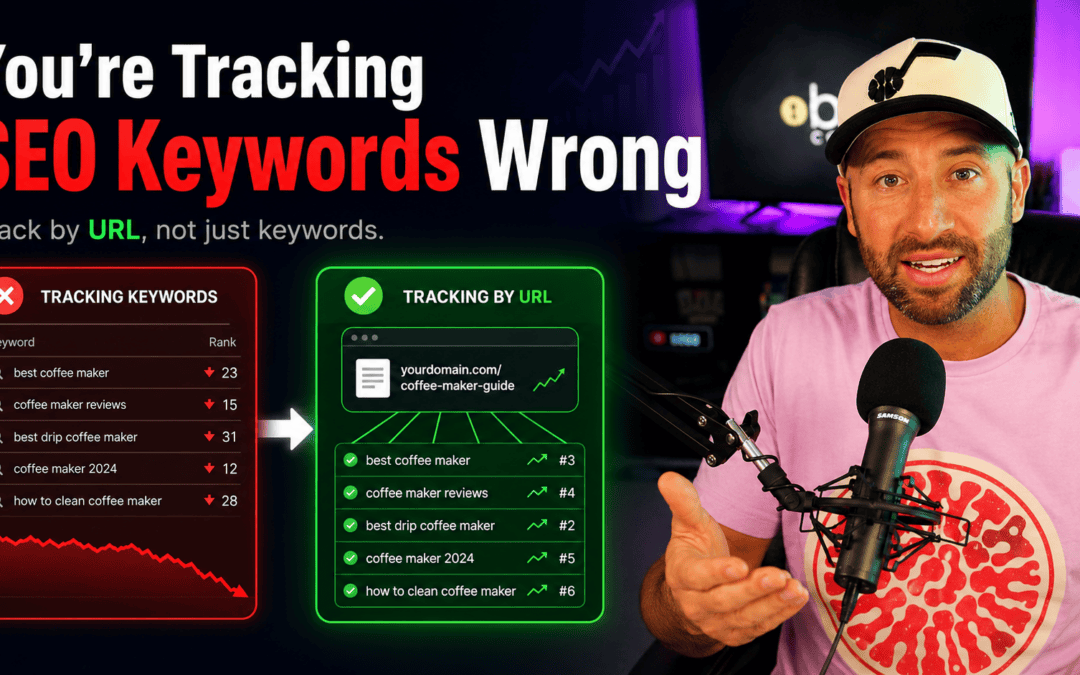
Most businesses track SEO the same way.
They build a list of 25, 50, or maybe 100 keywords they want to rank for. Then they plug those keywords into a rank tracking tool like Semrush, Ahrefs, Moz, or another SEO platform. Every month, they check the report.
A few keywords moved up. A few moved down. A bunch did not move at all. Then the business owner looks at the report and thinks, “Well, I guess SEO isn’t working.”
But here’s the problem: that report only shows the keywords you hoped to rank for. It does not show you all the keywords Google is actually ranking your pages for. That is where many businesses miss some of their biggest SEO opportunities.
If you want a clearer picture of your SEO progress, you need to stop only tracking keywords and start tracking your SEO performance by URL.
Watch the full video breakdown here:
Traditional Keyword Tracking Is Not Bad, But It Is Limited
Traditional keyword tracking (or position tracking) has a place in SEO.
At BKA Content, we use position tracking for many of our clients (typically in Semrush). It helps show whether a specific set of important keywords is moving up, down, or staying flat over time.
For example, a local business may want to track keywords like:
- best plumber in Denver
- emergency plumber in Salt Lake City
- roof installation in Dallas
- custom home builder in Northern Utah
Those keywords usually connect to a main service, location, or product. Tracking them can help you understand whether your site is gaining visibility for the terms you care about most.
But if this is the only way you measure SEO success, you are only seeing part of the picture.

Position tracking usually answers one question:
Are we ranking for the exact keywords we picked?
That is a helpful question, but it is not the only question you should ask.
A better question is:
What keywords is Google rewarding this page with?
That question opens up a much bigger SEO opportunity.
Every Page Can Rank for More Than One Keyword
One of the biggest mistakes people make with SEO is thinking of one page as targeting one keyword. This is bad SEO advice that has been shared for years.
In reality, a single page can rank for dozens, hundreds, or even thousands of related search terms.
Your homepage, service pages, location pages, guides, resources, and blog posts can all rank for more than the one keyword you originally had in mind. That means you may publish a page hoping it ranks for one phrase, but Google may start ranking it for a different phrase that is still highly relevant and valuable.
If you are only watching the keyword you originally chose, you may completely miss the keywords that are already working. And those keywords can be your fastest path to better rankings.
Why Tracking by URL Gives You Better SEO Data
Tracking by URL means looking at each important page on your website and asking:
What keywords does this specific page rank for?
Instead of only checking your chosen keyword list, you look at the actual search terms Google associates with that page.

This gives you better data because it shows you:
- keywords you did not know you were ranking for
- long-tail keywords that may be easier to improve
- keyword patterns Google already connects to your content
- pages that are gaining visibility even if your main keyword is not moving yet
- opportunities to reoptimize content around what is already working
This is especially important if your website is newer or still building authority.
Newer sites usually struggle to rank right away for big, competitive keywords. But they may start ranking for longer, more specific keywords first.
Those early rankings matter. They show you where Google is beginning to trust your content.
A Real Example: The Keyword You Target May Not Be the Best SEO Opportunity
On our blog we created a blog targeting the keyword “YouTube keyword tips.”
After about 90 days, we checked our position tracking report and saw that the article ranked around position 58.
While that felt like a small win to get it to rank for that keyword, it wasn't ranking high enough to get traffic yet. Traditional SEO tracking would tell us to keep watching that keyword and hope it moves up.
But when we looked at the URL itself, we found a much more useful story.
When we checked all the keywords that specific page ranked for, we discovered that the article also ranked for phrases like “how to add keywords to YouTube videos.”
That keyword had lower search volume, but it had clear intent. The searcher knows exactly what they want to learn.
Even better, the page already ranked much higher for that term than it did for the original keyword we targeted.
That was a huge clue.
Google was literally telling us, “This page is a better fit for how to add keywords to YouTube videos than it is for general YouTube keyword tips.”
Once we saw that, we were able to make smarter SEO decisions. Instead of trying to force the page to rank for the original keyword, we re-optimized the page around the keyword Google was already rewarding it for.
Re-optimization of the page included updating the title, headings, introduction, examples, FAQs, and supporting content to better match the phrase that was already gaining traction. After doing that, we saw much faster wins utilizing the new keyword phrase.

In many cases, this approach leads to faster SEO wins because you are building on existing momentum.
Stop Forcing Keywords and Start Following the Data
Keyword research is still important. You should understand what people are searching for before you create content.
But after you publish a page, the data should guide your next move.
Sometimes the keyword you wanted to rank for is not the keyword Google sees as the best fit for that page. That does not mean the page failed. It means you need to pay attention to what Google is actually showing you.
If a page ranks for 10, 20, 30, or 50 related keywords, that data can help you improve the page in a smarter way.
Instead of guessing, you can look for patterns.
- Are several keywords asking the same question?
- Are people looking for a more specific version of your topic?
- Is the page ranking for a service variation you did not emphasize enough?
- Is Google connecting the page to a location, problem, product, or how-to angle?
Those patterns can tell you exactly how to update your content.
How to Track SEO by URL
You can track SEO by URL using tools like Semrush, Ahrefs, Google Search Console, or other SEO platforms.
The process is simple:
- Choose an important page on your website.
- Look up that exact URL in your SEO tool.
- Review all the keywords that page currently ranks for.
- Look for keywords that are already ranking on page one, two, or three.
- Identify terms with clear intent and realistic opportunity.
- Optimize these keywords in your content to better support the keywords that are already working.
- Track the page again over time to see how the rankings change.
The goal is not to abandon your primary keyword every time.
The goal is to understand the full keyword footprint of each page so you can make better SEO decisions.
What to Look for When Reviewing a URL's Rankings
When you review a page’s ranking keywords, do not only focus on search volume. Search volume matters, but it is not everything.

You should also look for:
High-intent keywords
These are keywords where the searcher clearly wants something specific. A keyword with 50 searches per month can still be valuable if the intent is strong.
Keywords ranking in positions 5-30
These are often your best optimization opportunities. If a page is already close to ranking well, small improvements may help it move higher.
Repeated keyword patterns
If several ranking terms include the same phrase or question, Google may already understand that your page is relevant to that topic.
Keywords that better match the page
Sometimes the ranking data reveals that your content naturally answers a slightly different question than the one you originally targeted.
Related content opportunities
If a page ranks for keywords that deserve their own dedicated article or service page, that can help you plan future content.
Why This Matters for Small Businesses
Small businesses cannot afford to waste time guessing with SEO. You need a strong SEO roadmap to be competitive.
If you only track a short keyword list, you may think your SEO campaign is not working when your pages are actually starting to gain traction. You just are not looking in the right place.
Tracking by URL gives you a clearer view of what is happening.
It helps you see which pages are starting to perform, which keywords Google is associating with your site, and where you have the best chance to grow next.

This is especially helpful when you are just starting out because you probably will not rank for your biggest keywords right away.
But you can often win smaller, more specific keywords first. Those wins build momentum. Over time, that momentum can help your site earn more visibility for bigger keywords.
The Smarter Way to Measure SEO Progress
Your main keyword list still matters, but it should not be the only thing you track. If you want to understand whether your SEO content is really working, track your pages too.
Look at each URL and ask:
- What keywords does this page rank for?
- Which terms are improving?
- Which terms are close to page one?
- Which keywords show real search intent?
- What is Google already rewarding this page for?
- How can we improve the page based on that data?
This turns SEO from a guessing game into a data-driven process.
You stop trying to force pages to rank for keywords they may not be ready for. Instead, you build around the signals Google is already giving you.
Need Help Finding Your SEO Opportunities?
If you want help finding the pages and keywords that are already working on your website, BKA Content can help.

You can request a free site content audit, and we’ll help highlight your performing pages, keyword opportunities, and areas where your content may be able to grow faster. We offer full SEO services for small businesses looking to have experts help them get found on AI search.
Or, if you would rather learn how to do this yourself, you can join the BKA SEO & Digital Marketing Academy on Skool. Inside the community, you’ll get access to practical SEO training, tools, and live support from experienced SEO strategists.
The bottom line is simple:
Do not only track the keywords you hope to rank for.
Track your URLs, study what Google is already rewarding, and use that data to make smarter SEO decisions.

- How to Add Social Media Accounts to Google Search Console - July 30, 2026
- You’re Tracking SEO Keywords Wrong: Why You Should Track by URL Instead - June 11, 2026
- How to Track AI Traffic in Google Analytics (Step-by-Step Tutorial) - March 24, 2026
