
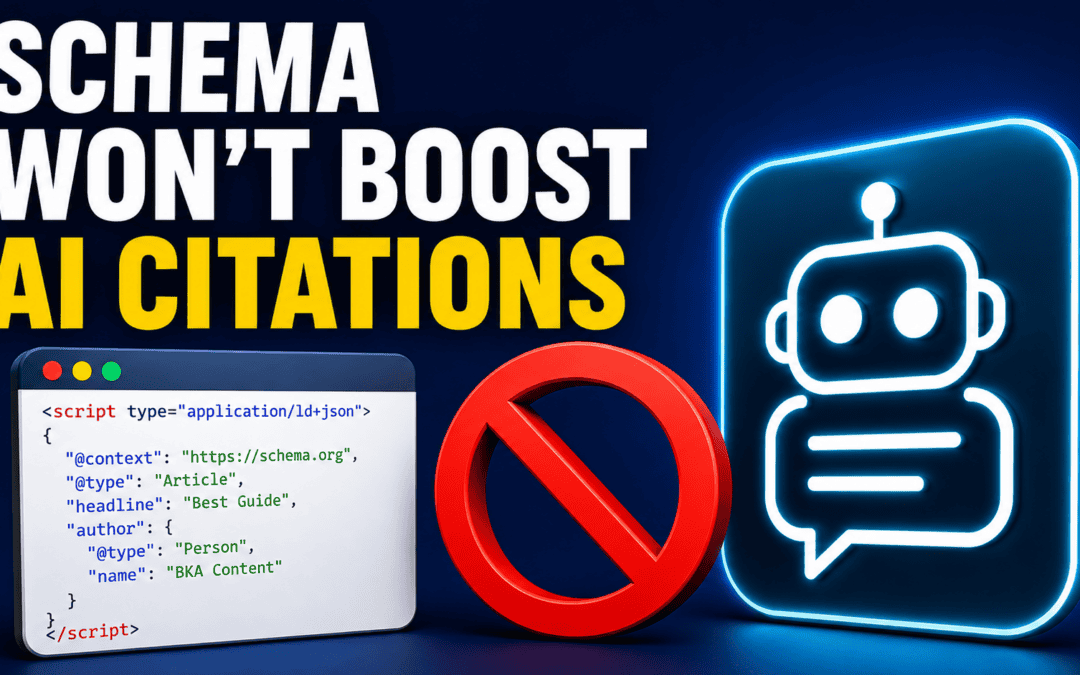
Schema markup has been getting a lot of attention lately. Many people think it may help their pages show up in AI answers.
The idea makes sense at first. Schema gives search engines extra details about a page. It can tell Google that a page is a blog post, product page, FAQ page, recipe, local business page, or something else.
So, many marketers have asked the same question:
Does schema markup help pages get cited by AI tools?
A new Ahrefs study says the answer is probably no. At least, not by itself.
Ahrefs looked at 1,885 pages that added JSON-LD schema. Then they checked whether those pages got more citations in Google AI Overviews, Google AI Mode, and ChatGPT.
The results were small. Some pages saw tiny gains in AI citations. Some saw drops. Overall, Ahrefs did not find strong proof that adding schema caused more AI citations.
That doesn’t mean schema is useless. It means schema is not a shortcut.
What Ahrefs Found

Ahrefs did not just compare pages with schema to pages without schema. That would not be a fair test.
Strong websites often do many things well. They may have better content, more backlinks, stronger brands, and cleaner site structure. Those same sites may also use schema.
So, schema may be present on strong pages without being the reason those pages get cited.
To get a clearer answer, Ahrefs looked at pages before and after they added schema. Then they compared those pages to similar pages that did not add schema.
The main finding was simple: adding schema did not lead to a clear rise in AI citations.
Google AI Mode citations went up a little. ChatGPT citations also went up a little. But the gains were too small to treat as proof. Google AI Overview citations even dropped for some pages, but that does not mean schema hurt them.
The safest takeaway is this: schema alone did not move the needle.
Why This Matters

A lot of businesses want to show up in AI search.
That makes sense. More people are using tools like ChatGPT, Gemini, Perplexity, and Google AI Overviews to find answers. If your business gets cited in those answers, more people may learn about your brand.
Because of that, many people are looking for easy AI SEO wins.
Schema markup has been one of the most common ideas. Add a bit of code, help AI understand the page, and earn more AI citations.
But the Ahrefs study shows that the answer is not that simple.
AI tools seem to care more about the page itself. They need clear answers. They need useful details. They need trust. Schema can help label a page, but it can’t turn weak content into a strong source.
Schema Still Has a Job

Schema markup still matters for SEO.
Google uses structured data to better understand pages. Schema can also help pages qualify for rich results. These are search features like review stars, product details, recipe info, FAQ-style results, and other enhanced listings.
So, businesses should not remove schema. They also should not ignore it.
Schema works best when it supports content that is already on the page. For example:
- A blog post can use Article schema.
- A local business page can use LocalBusiness schema.
- A product page can use Product schema.
- A real FAQ section can use FAQ schema.
The key is to keep schema honest.
Don’t add schema for content that users can’t see. Don’t mark up fake reviews, fake FAQs, or details that are not really on the page. Schema should help search engines understand the page, not trick them.
What Helps More Than Schema?

Strong content helps more than schema.
AI tools need pages that answer questions in a clear way. If a page is vague, thin, old, or hard to read, schema won’t fix that.
A better AI search strategy starts with the visible content. The page should answer the main question early. The writing should be simple. The page should include useful facts, examples, and related questions.
AI-ready content often includes:
- A clear answer near the top of the page
- Simple headings that match real questions
- Helpful FAQs based on customer needs
- Original tips, examples, or data
- Strong internal links to related pages
- Clear author or company details
Original details matter too. AI tools have many pages to choose from. A page that says the same thing as everyone else may not be the best source. A page with expert tips, first-hand knowledge, examples, or data has a better chance of standing out.
What Businesses Should Do Now
Businesses should still use schema markup. But schema should be one part of the SEO plan, not the whole plan.
Start with the page itself. Does the page answer the search question clearly? Does it give enough detail? Does it sound helpful? Would a real person trust it?
After that, add schema that matches the page. Use Article schema for articles. Use FAQ schema only when the page has real FAQs. Use Product schema only for real products. Use LocalBusiness schema for real local business details.
Then check the schema with a testing tool. Broken schema may not help at all. Bad schema can also cause problems.
Finally, track AI citations on their own. Regular SEO reports may not show whether AI tools are citing your content. Check Google AI Overviews, ChatGPT, Perplexity, Gemini, and other tools when they matter to your business.
The Bottom Line
Schema markup is still useful. It helps search engines understand your pages. It can also support rich results in Google.
But schema markup does not seem to be a fast path to more AI citations.
The Ahrefs study shows that adding JSON-LD schema did not lead to a clear boost in AI citations. That means businesses should not rely on schema alone.
The better plan is simple: write clear, helpful content. Answer real questions. Add useful details. Build trust. Then use schema to support that work.
Schema can help explain your content. It can’t do the hard work for you.
Learn How To Rank In AI Search
Want to learn how to rank in AI Search in as little as 24 hours? We'll show you how to do this using a content strategy that we've used for ourselves and our clients. Join our BKA Content SEO & Digital Marketing Academy on Skool to learn step-by-step how to get your first SEO asset to rank on Google Search, AI Overview and ChatGPT.

- Rank Tracking Accuracy: What to Check Before You React - October 23, 2026
- Most SEO Advice for Beginners Is Backwards - May 28, 2026
- How Long Does It Take To Learn SEO in 2026? - May 28, 2026
