
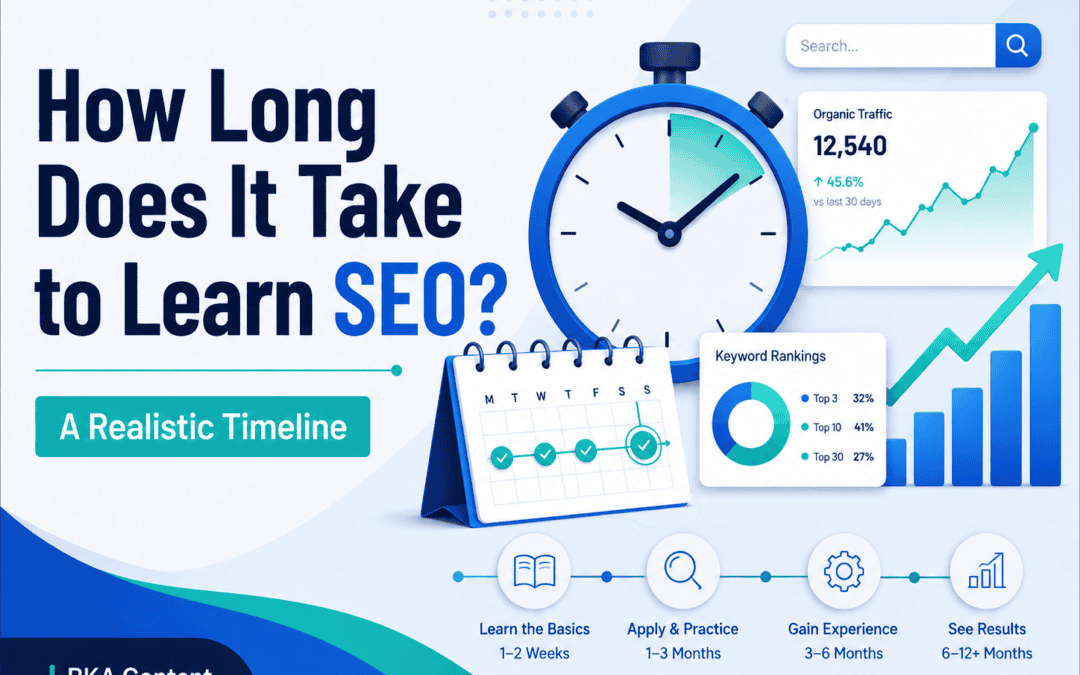
Most beginners can learn the basics of SEO in 2 to 6 weeks with the help of a DIY SEO course and steady practice. Learning enough SEO to improve a real website usually takes 3 to 6 months. Building the skill to plan, troubleshoot, and measure a full SEO strategy can take 6 to 12 months or longer.
So, how long does it take to learn SEO? The answer depends on your goal. Learning what SEO means is quick. Learning how to use keyword research, on-page SEO, technical SEO, content strategy, link building, and analytics together takes more time.
This guide breaks down a realistic SEO learning timeline for beginners, small business owners, marketers, and anyone who wants to understand how SEO works.
How Long Does It Take To Learn SEO?
Learning SEO usually takes:
- 1 to 7 days to understand what SEO is
- 2 to 6 weeks to learn SEO basics
- 3 to 6 months to apply SEO to a real website
- 6 to 12 months or longer to become confident with strategy, reporting, and troubleshooting
SEO is easier to learn when you follow DIY SEO Courses and practice on a real website instead of only watching tutorials. The fastest learners usually pick one website, choose a few keywords, optimize pages, publish helpful content, and track results in Google Search Console.
SEO Learning Timeline for Beginners
| Learning Goal | Realistic Timeline | What You Should Be Able To Do |
|---|---|---|
| Understand SEO basics | 1 to 7 days | Explain how search engines find, understand, and rank pages |
| Learn beginner SEO skills | 2 to 6 weeks | Do basic keyword research, improve headings, write title tags, and optimize content |
| Apply SEO to a website | 2 to 3 months | Update pages, add internal links, publish SEO content, and track early movement |
| Run a simple SEO campaign | 3 to 6 months | Plan content, monitor rankings, review Search Console data, and improve pages |
| Build advanced SEO skill | 6 to 12+ months | Diagnose technical issues, analyze competitors, build a content strategy, and adjust based on data |
| Stay current | Ongoing | Keep up with Google updates, AI search changes, and new SEO tools |
What Can You Learn in the First Month?

In the first month, most beginners can learn the core parts of SEO. That includes keyword research, search intent, title tags, meta descriptions, headings, internal links, and basic content optimization.
A good first-month goal is not to master SEO. A better goal is to understand how SEO works and improve one real page.
For example, you could choose one blog post, find a better keyword, rewrite the title, improve the introduction, add clearer headings, and connect the page to related content with internal links.
By the end of the first month, you should know how to answer these questions:
- What keyword is this page targeting?
- What does the searcher want?
- Does the page answer the question quickly?
- Are the headings clear?
- Are related pages linked together?
- Can I track impressions and clicks in Google Search Console?
What Takes Longer To Learn in SEO?
Advanced SEO takes longer because it requires judgment. Anyone can learn what a title tag is. It takes more practice to understand why one page ranks and another page does not.
The SEO skills that usually take the longest to learn include:
- Technical SEO: site speed, indexing, redirects, crawl issues, canonical tags, and structured data
- Content strategy: choosing the right topics, building topical authority, and updating old content
- Link building: earning trustworthy links without using spammy tactics
- Analytics: knowing which SEO changes are working and which ones are not
- AI search optimization: formatting helpful answers, adding original insight, and building brand trust across search experiences
SEO learning never really stops. The basics stay useful, but search results, tools, and AI-powered search features keep changing.
What Affects How Fast You Learn SEO?

Several factors affect how long it takes to learn SEO.
Your starting point matters. Someone with writing, web design, analytics, or marketing experience may learn SEO faster than someone starting from zero.
Your practice time matters too. Studying SEO for one hour a week will lead to slower progress than practicing several times a week on a real website.
The type of SEO you want to learn also matters. Local SEO, ecommerce SEO, technical SEO, content SEO, and AI search optimization all require different skills.
Hands-on practice is usually the biggest factor. SEO starts to make more sense when you publish, measure, adjust, and repeat.
Learning SEO from an expert can also greatly speed up the learning time. Join our BKA SEO & Digital Marketing Academy on Skool to learn
Can You Teach Yourself SEO?
Yes, you can teach yourself SEO. Many business owners and marketers learn SEO through free guides, courses, YouTube tutorials, SEO tools, and practice.
The best self-taught SEO path is simple:
- Learn how Google Search works.
- Study keyword research and search intent.
- Optimize one existing page.
- Write one new SEO-focused article.
- Add internal links between related pages.
- Track impressions, clicks, and rankings.
- Improve the page based on what the data shows.
Self-teaching works best when you avoid jumping between too many tactics. Focus on one site, one topic cluster, and one clear goal at a time.
Is SEO Hard To Learn?
SEO basics are not hard to learn. Most beginners can understand keywords, headings, title tags, internal links, and helpful content within a few weeks.
SEO becomes harder when you need to make decisions with incomplete data. A page may fail to rank because the keyword is too competitive, the content is too thin, the site lacks authority, the page has technical issues, or the search intent is wrong.
That is why SEO is part knowledge and part practice. The more pages you optimize, the easier it becomes to spot patterns.
How Many Hours To Learn SEO?

Learning SEO and seeing SEO results are not the same thing. You can learn the basics in a few weeks, but SEO results often take longer.
Some changes, such as rewriting a title tag or improving internal links, may show movement within a few weeks. Bigger SEO gains often take several months, especially for new websites or competitive keywords.
A good rule is to review early data after a few weeks, then keep improving the page over the next 3 to 6 months.
A Simple 30/60/90-Day SEO Learning Plan
A timeline makes SEO easier to learn because it gives you a clear order to follow. Here is a simple plan for beginners.
Days 1–30: Learn the Basics
During the first 30 days, focus on the foundation. Learn what SEO is, how Google Search works, and how keywords connect your content to searchers.
Your first-month tasks should include:
- Learn basic SEO terms
- Study search intent
- Choose one website to practice on
- Set up Google Search Console
- Find 5 to 10 beginner-friendly keywords
- Optimize one existing page
- Add internal links to related pages
The goal is not perfection. The goal is to understand how small SEO changes affect a real page.
Days 31–60: Practice on Real Pages
During the second month, start applying SEO to more pages. This is where SEO begins to feel less abstract.
Your second-month tasks should include:
- Update 2 to 4 existing pages
- Write one new SEO-focused blog post
- Improve title tags and meta descriptions
- Add clearer headings
- Add helpful FAQs
- Link related pages together
- Check early impressions and clicks in Search Console
At this stage, focus on learning from the data. Some pages may improve faster than others. That is normal.
Days 61–90: Build a Repeatable SEO Process
During the third month, start building a simple SEO workflow you can repeat.
Your third-month tasks should include:
- Review which pages are gaining impressions
- Improve pages that are close to ranking higher
- Build one small topic cluster
- Compare your content against top-ranking pages
- Check for basic technical issues
- Track keyword movement
- Plan your next 5 to 10 content updates
By the end of 90 days, many beginners can understand the SEO process well enough to keep improving their website.
What We See Beginners Struggle With Most

At BKA Content, we work with small business owners, marketers, and agencies at different SEO skill levels. The beginners who make the fastest progress usually do three things well.
First, they choose specific keywords instead of broad ones. For example, “local SEO for dentists” is easier to act on than “SEO.”
Second, they update existing pages before writing dozens of new ones. A refreshed page can teach you more about SEO than a stack of unfinished blog drafts.
Third, they track results. Google Search Console helps show whether a page is getting more impressions, clicks, and keyword visibility after changes are made.
Most beginners do not need to learn everything at once. They need a simple process they can repeat.
How To Learn SEO Faster
You can learn SEO faster by focusing on practice instead of passive learning. Watching SEO videos from BKA Content and reading guides can help, but SEO starts to click when you apply what you learn.
Here are a few ways to learn SEO faster:
- Pick one website to practice on
- Start with low-competition keywords
- Optimize existing pages before writing new ones
- Learn search intent before advanced tactics
- Use Google Search Console every week
- Study the pages already ranking for your target keyword
- Keep notes on what you changed and what happened next
- Avoid trying to learn every SEO tool at once
A simple process is better than trying random SEO tips from different sources.
Should You Learn SEO Yourself or Get Help?
You can learn SEO yourself if you have time to practice and patience to test what works. This can be a good option for small business owners, bloggers, freelancers, and marketers who want to understand the basics.
Getting help may be better if you need faster direction, have a large website, or are dealing with technical SEO problems. A strategist or SEO team can help you avoid wasted time and focus on the changes most likely to improve search visibility.
Many businesses use both options. They learn enough SEO to understand the strategy, then get expert help with content planning, technical fixes, or ongoing SEO work.
Want a Simple Way To Learn SEO and AI Search?

Join the BKA Content SEO & Digital Marketing Academy on Skool, the beginner-friendly place to learn how to get your business found on Google, AI search, and local search without feeling overwhelmed.
You’ll find step-by-step SEO lessons, AI search tips, community support, and practical tutorials you can apply to your own website.

- Rank Tracking Accuracy: What to Check Before You React - October 23, 2026
- Most SEO Advice for Beginners Is Backwards - May 28, 2026
- How Long Does It Take To Learn SEO in 2026? - May 28, 2026
