Key Takeaways:
- An SEO content audit shows you what content is already helping your rankings, traffic, and AI visibility—and what to improve next.
- Prioritize existing pages with momentum (keywords ranking in the top 100, especially positions 11–20) before publishing new content.
- Use SEMrush to review Authority Score, backlinks/referring domains, keyword count, and 12-month trends to understand your baseline.
- Separate your site into Performing Pages (top 10 rankings) and Opportunity Pages (ranking, but not top 10 yet).
- Strong results usually come from improving: home page+ service pages + location pages +industry pages+ internal linking + blog strategy (not random posting).
- For local businesses, your Google Business Profile, reviews, and NAP consistency can directly impact map pack visibility.
How to Perform an SEO Content Audit
If your website isn’t ranking, getting traffic, or earning AI mentions, the issue isn’t necessarily that you need more content. The issue may be that you don’t know what’s already working, what’s close to working, and what’s holding your site back.
That’s exactly what an SEO content audit for your website aims to solve.
This completed guide walks through how to do an SEO content audit using the same exact framework we use at BKA Content to uncover hidden opportunities, improve existing pages, and build a clear SEO content roadmap for our clients.
What Is an SEO Content Audit?
An SEO content audit is the process of reviewing all of the content on your website to see which pieces of content are assets to ranking, and which may be a liability. Through this SEO audit of your website content, you can determine:
- Pages that already rank and bring in visibility (through traffic, impressions, or AI mentions)
- Pages that rank but need additional improvement to drive traffic
- Missing pages you should have on your site (services, locations, industries, resources/guides)
- Content and backlink gaps that competitors are winning
- How your site structure supports (or limits) growth on search engines
By analyzing this data, you can start to see how your site structure supports (or limits) organic growth on Google and AI Search Engines.
SEO Content Audit vs Technical SEO Audit
Another thing to understand is how an SEO content audit differs from a technical SEO audit. A lot of SEO agencies will sell you on an expensive technical SEO audit where all they are doing is putting your website into a software that spits out an extremely long report of (mostly) unreadable items. A technical SEO audit usually focuses on:
- Broken links and 404 errors
- Missing title tags/meta descriptions
- Page speed issues
- Indexing and crawl problems

While there are merits to a technical SEO audit, you can quickly get lost in the technical jargon, and it ultimately does little to explain areas of concern (when it comes to ranking online for target keywords) or identify large areas of opportunity on your website. If there are obvious technical issues with your site (i.e., broken main pages, very long loading times), this is usually necessary, but I don't typically lead with a technical SEO audit with any of my clients.
In contrast, an SEO content audit focuses on:
- What pages you have
- Whether or not they rank, how highly they rank and keywords they rank for
- Whether the keywords on these pages match search intent
- Which pages are worth improving first and which pages are missing
If you want organic results, an SEO content audit often gives the clearest next steps because content is what search engines (and AI tools) actually use to understand your business. The way you've structured your content and the way Google currently ranks it will give you an enormous amount of insight into how what you've done up to this point has driven ranking.
SEO Content Audit Checklist
Here’s the exact checklist we follow when performing an SEO content audit for a client's website:
- Review website history and baseline performance
- Audit backlinks and referring domains
- Review keyword rankings and trends (12 months)
- Export all ranking keywords for a site and map them to pages
- Identify performing pages and opportunity pages
- Review site navigation and structure
- Audit service pages, location pages and industry pages
- Review blog strategy and content quality
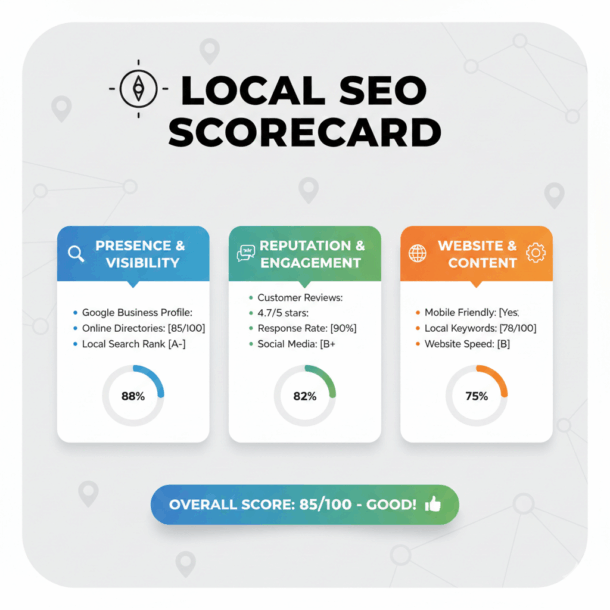
- Check local SEO (GBP, reviews, citations)
- Build a prioritized SEO content roadmap
Here's a little infographic you can save (if you prefer a visual format) to help you remember all the steps in an SEO content audit checklist:

Step 1: Review Website History & Performance in SEMrush
The very first step in an SEO content audit is to start by understanding where your website stands right now. For this step, you'll need to use SEMrush, or a similar keyword research tool, to be able to find a complete list of the keywords that rank on your site (in addition to some other metrics).
If you don't already subscribe to an SEO tool like this, you can use our Semrush free trial link to get access for a week or sign up for a discounted membership. Once inside, here are the things you'll want to look at:
Check Authority Score (Domain Authority)
This is called something different depending on the tool, but most SEO keyword research tools use a score to rate the overall authority of your site. In Semrush, this is called the authority score, and here's what you need to know about it:
- A 0–100 score estimating overall site authority
- Many local, small businesses fall in the 5–30 range
- To get past a score of 50 you have to basically be a .edu site (doing University SEO) or a mega corporation with a bottomless pit of money
- The higher the score, the better, but trends matter more than one number
When doing your SEO content audit, go to the "Domain Overview" section of Semrush, type in the main URL of your site there you'll find the Authority Score:

The higher the authority score, the easier path you have to ranking for new terms, but trends and trajectory ultimately matter more than just a single metric like this.
Step 2: Find Total # of Backlinks & Referring Domains
While backlinks don't necessarily equate to "content", they are relevant to an SEO content audit in that they show the quality level of your content (or at least what you want Google to think the quality is). Also, the number of backlinks your website has, and the number of unique referring domains pointing back to you, are heavily weighted in the Authority Score we showed above.
To find this backlink profile information, stay in the "Domain Overview" section of Semrush, scroll to the right of your page and look at both:
- Total backlinks (total links pointing to your site)
- Referring domains (unique websites linking to you)

A healthy backlink profile usually includes diverse referring domains, not just lots of links from one site. You'll sometimes find you have hundreds of backlinks from a single site (most likely a spam directory), and it inflates your total # of backlinks. That's why looking at both of these metrics together helps you to make sure you are getting the number of backlinks you need, but that they are also coming from new sources.
Typically, I like to see that at least 10-20% of the backlinks you are getting are from unique domains. If you can get to 50% or above, you've got a very diverse backlink profile - which is great!
Step 3: Look at Organic Keywords, Estimated Traffic & Trends
Ok, now we're getting into the metrics that more directly correlate with whether your content is an asset, a liability, or a non-factor. One of the best being that of keywords ranking per page.
While we are going to also look at the estimated traffic numbers that Semrush gives us, take these with a grain of salt. From the hundreds of small businesses we've worked with at our Utah SEO agency, it's very clear that Google Analytics traffic numbers and Semrush traffic numbers don't line up. That's ok! The traffic numbers in Semrush still correlate to rises and lifts in analytics numbers, even if they aren't exact matches, so they can still be helpful in an SEO content audit.
To find this information in Semrush, go to the "Organic Keywords" section on the left, and then again type in the main URL of your site. Here you'll find:
- Total number of keywords ranking in the top 100
- Estimated site traffic
- Keyword ranking trend over time

What You Want to See
During this step in your SEO content audit, there are a few things to look for that will denote if your website is heading in the right direction:
- Consistent history of ranking for keywords (not disappearing and reappearing)
- A gradual upward trend in keywords and visibility
- A keyword profile of 100+ keywords across the site
- Evidence your site can rank for relevant terms
While your site doesn't NEED to currently rank for 100 keywords, it usually means you have enough site depth and relevant content to make this site content audit a little more worthwhile. If you have a brand new site you may have less than 100 keywords, and that's perfectly fine.
What You Don't Want to See
If your site is NOT new and you only rank for a handful of keywords (AND you have a decent amount of content on the site), that's concerning.
At this point, a technical audit might make sense, and a new site rebuild may be in order.
Review Top Keywords for Relevance
Just because you rank for keywords doesn't mean your site is in good shape. Just as important as the number of keywords is how relevant they are to what your business actually does to make money. Here's how to quickly check and see if your "top keywords" are helping (or hurting) your site.
When in Semrush, stay on the "organic keywords" section in the left nav and just scroll down the page to the "Top Keywords" section:

Once you've found your top keywords, here are some key questions to ask:
- Are branded keywords ranking (#1 for your business name)?
- Are you ranking for relevant service + location terms?
- Do you have any informational keywords ranking (blog opportunities)?
If you're ranking for relevant terms, you know that you're on the right track. You may need more content, more SEO optimization, and more relevant keywords, but it's a good place to start from. If you aren't ranking for relevant terms, you now need to find out what pages on your site are swaying your top keywords. You may want to repurpose this content, re-optimize it around relevant terms or just delete it altogether.
No matter what you find in this step of your SEO content audit, this will help inform the rest of your analysis as well as your future content strategy.
Compare SEO Metrics to Competitors
While I didn't make this its own numbered step in the SEO content audit checklist, a quick competitor snapshot helps you understand whether you’re close or far from the leaders. Once your site audit is done, you'll likely do a deep dive of your competitors to help you create your SEO content strategy and action plan, but I still like to do a baby version of this at this point in the audit.
Here's what you'll compare:
- Authority Score
- Backlinks / referring domains
- Total ranking keywords
- Estimated traffic

And like I said before, this doesn’t replace a full competitor analysis later—it just helps you set expectations and priorities. If you're WAY behind in any one of these metrics, you may need to find a better competitor to compare yourself, too. Or, you just have some extra work to do!
Step 4: Export All Ranking Keywords and Map Them to Pages
This is where most SEO content audits go from “interesting” to “useful.” This is also the step where you'll need one additional tool to help you look at Semrush data through a "content" lens. But before we do that, let's get one last report from Semrush that includes EVERY keyword your website ranks for.
To do this, go to the bottom of the "Top Keywords" section you were just in and click on "all keywords". From there, scroll down and on the right-hand side of your screen select Export > All > Excel.

One quick note - this export option works for sites that have 30k keywords or fewer. If you have more than 30k keywords, you'll need a custom approach to downloading keywords so you might as well just have SEO content exports like us do it for you,
In this report (from SEMrush) you'll want to make sure that you have:
- Keyword
- Ranking position
- URL ranking for that keyword
- Search volume
- Keyword difficulty
Input Total Website Keywords into SEO Content Audit Worksheet
Remember how I talked about needing one additional tool to do this part? Ok we are at that step. Next, you'll need to download this SEO content audit worksheet we created.
First, open up the keyword list you downloaded from Semrush and copy the entire sheet of data. Next, open up that SEO Content Audit worksheet and on the bottom right, go over to the "KW Report" tab and paste in the Semrush keyword data.

Once the keywords are in here, it will automatically map them to your performing and opportunity pages tabs so you can evaluate performance by URL instead of by “a list of target keywords.”
Step 5: Identify Performing Pages vs Opportunity Pages
For simplicity's sake, I've made this SEO content audit worksheet so that it separates content between either "performing pages" or "opportunity pages". Here's how I define both:
What are Performing Pages on Your Website?
Performing pages are URLs ranking in the top 10 for at least one keyword.
These are high value because they already earn:
- Clicks
- Traffic
- Visibility
- More AI citations/mentions

Ranking for keywords on a page in the top 10 is not the end-all be-all for performance, but it is a good metric for momentum when it comes to organic growth.
What are Opportunity Pages?
Opportunity pages on your website are defined as URLs ranking for keywords in positions 11–100.
These are often some of the best pages to focus on first because Google already recognizes them, improvements on these pages typically hold more weight, and the ROI is usually higher on these pages than publishing new content from scratch.

Important: ranking is hard. If a page ranks for anything at all, don’t waste that progress.
What to Look for When Auditing Ranking Content
When looking at performing pages, you want to see a mix of both main pages on your site (think home page, service pages, location pages or industry pages) as well as top of funnel (ToFu) content like blog posts. Ideally your home page is the top performer, followed by main pages, followed by some extremely relevant blog posts.
For the opportunity pages, you're looking to see if the pages rank for terms you intended, and if so, go back and re-optimize these pages for these terms, add new content, videos, etc. OR, if you're ranking for terms you didn't intend, reoptimize around these new terms and change the content trajectory of the page to fit. This is where you maximize what you've already built while strategically altering your content to fit what it's already ranking for.
Step 6: Website Structure Audit
Now that we've filtered and categorized our pages, it's that time in an SEO content audit where we actually go to the website and see what's missing. To do that, you need to review your site like a user and like Google:
Main Navigation Essentials
Your main navigation needs to be simple to use and highlight the best/most important parts of your website. It should typically include:
- Home
- Services
- Individual page for each main service
- Locations (if relevant)
- Individual pages for each main location where you offer services
- Industries (if relevant)
- Individual pages for each main industry you serve
- Pricing
- About
- Contact
- Blog/Resources
Here's a quick diagram of what a strong SEO site structure might look like:

One key thing content audit aspect to note: If your blog isn’t in the main navigation, that’s a huge missed SEO signal.
Homepage SEO Audit
When it comes to content on your homepage, it needs to be both SEO-optimized and crystal clear for potential customers. Your homepage should quickly answer:
- What do you do?
- Where do you do it?
- Who do you serve?
Avoid vague industry jargon. Clear messaging supports both conversions and SEO. Also, utilize individual sections on your home page to cover services, locations, industries, what makes you different, and a little about you to give customers a snapshot of your entire business.
Step 7: Service Page, Location Page, and Industry Page Optimization Review
After the homepage, the service pages, location pages and industry pages are where you build real context for Google that you do these things for these customers in these places.
First, let's do an SEO audit of your service/location and (or) industry pages. Check each page for:
- Keyword in the URL slug
- Keyword in the H1 heading (and subsequent headings)
- Clear explanations and supporting content (not thin pages)
- Internal links to related services, locations and blog posts
- Image alt text that supports the topic

For local businesses, also check for:
- Strong location context (cities/areas served)
- Dedicated SEO location pages where needed
Popup-only service/industry descriptions can be difficult to index and don’t help AI tools understand your services. Remember, it's best from an SEO perspective to have individual pages made for all of your main services.
Step 8: SEO Blog Audit
A blog should not be a newsletter dumping ground. When used strategically, it can boost main pages on your site as well as bring in new keyword clusters your site wouldn't otherwise have.
A blog that supports SEO should:
- Target keyword-driven topics
- Answer real questions clearly
- Include internal links to service/location pages
- Add something original: examples, case studies, insights, photos, local context

When looking at overall SEO blog topics, they should have a direct link to whatever services you offer. Do not create slightly related blogs that obviously don't fit anywhere in the customer's buyer journey.
Otherwise, you run the risk of ranking for keywords that aren't related to your business profile and you can confuse Google on what kind of company you actually are.
Avoid “Obvious AI Content”
When writing your blog, it can be tempting to let AI generative tools like ChatGPT do all of the lifting. While I'm a huge proponent of utilizing these tools to analyze data, get you a skeleton for content, and format it succinctly, it should never be used as a content creation shortcut.
Google can easily spot AI-only written content that’s:
- Generic
- Overstuffed with bullet points
- Full of bolded filler
- Missing real examples or point of view
AI can help with structure—but your content still needs real substance. And as a pro SEO tip, adding a unique YouTube video about the content in your blog can go a long way in serving you up in multiple mediums on AI search.
Step 9: Local SEO Audit (For Local Small Businesses)
If you’re a local business, one of the last SEO content audit steps is to review your Google Business Profile (GBP). Look for things like:
- Business description includes services + locations
- Photos are uploaded consistently
- Posts/updates are active
- Review count and star rating are competitive
- Reviews are being responded to
- Citations and directory listings have consistent NAP (name, address, phone)

A strong GBP can help you win visibility even if your website needs content improvements. In fact, if you're a hyper-local business, this Google Business Profile Optimization should be your very first priority when creating a Local SEO strategy, and then your website should be built to support it.
Step 10: Build a Prioritized SEO Content Strategy
When your SEO content audit is complete, you should have a pretty good idea of what to do next. Here are some great places to start when creating your content roadmap:
- Improve opportunity pages closest to the top 10
- Expand performing pages to protect and grow rankings
- Build missing service/location/industry pages
- Fix internal linking between blog and main pages
- Align blog strategy to keywords your site can realistically win
From here, deeper keyword research, competitor analysis and SEO action plans become much easier (and more accurate). For more information on how to create an in-depth roadmap that works, see our SEO content strategy guide.
Want a Free SEO Content Audit?
BKA Content is a full-service digital marketing company specializing in SEO content strategy, creation, and implementation.
If you’re serious about taking your website to the next level, reach out for a free site audit. We’ll run this exact process for your website content audit and give you a clear roadmap for growth.
Prefer DIY SEO? Join our Skool community for SEO and AI search updates, peer support, master classes and courses and even weekly Q&A with SEO strategists for our premium tier!
No matter how you choose to do SEO for your site, we can help!

- How to Track AI Traffic in Google Analytics (Step-by-Step Tutorial) - March 24, 2026
- How To Use Keywords in Your Content for SEO - February 2, 2026
- The 10 Best Digital Marketing Agencies In Utah: 2026 List - January 6, 2026